
From lifting the old surface to the final pointing, a patio build follows a clear set of stages worth knowing before you book.
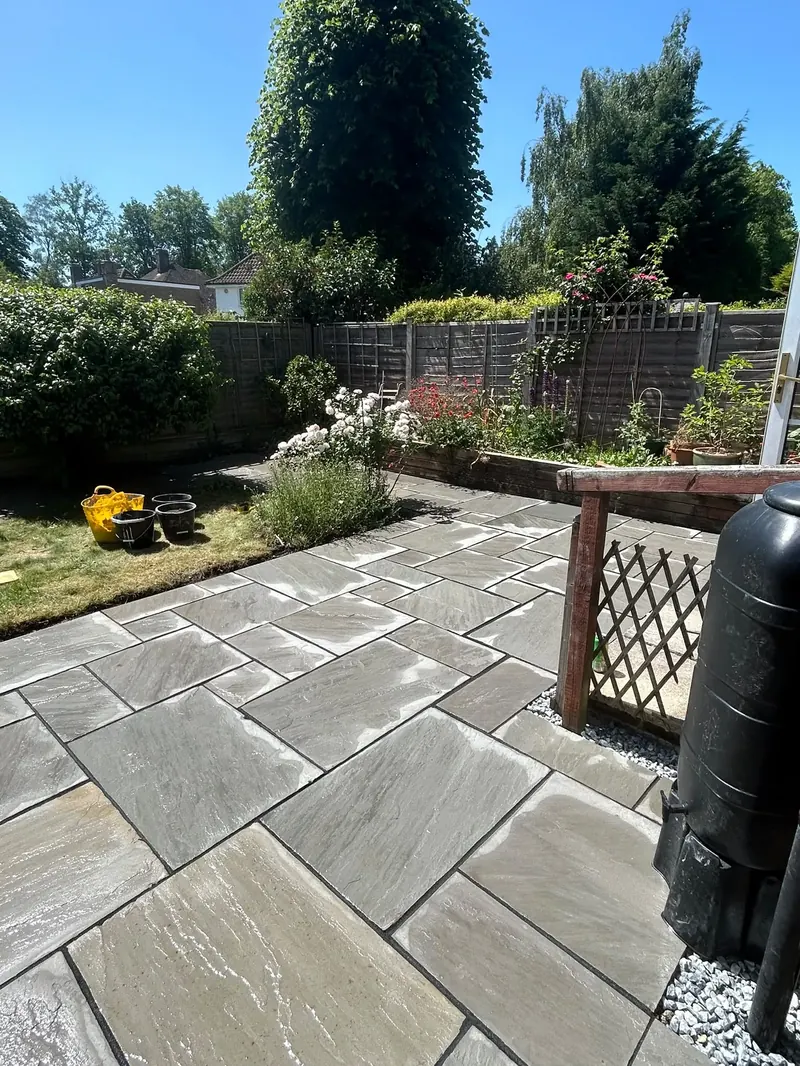
It's one of the first questions most people ask once they've decided to go ahead with a new patio: how long is my garden actually going to be a building site? The honest answer is "it depends", but the stages themselves are consistent whatever the size, so it's worth understanding what's actually involved before you try to put a number of days on it.
If you've asked more than one tradesperson for a rough timeframe and had noticeably different answers, that's usually less about differing speed and more about differing assumptions on ground conditions, access, and how much sub-base work is genuinely planned. A quote that skips proper compaction in layers will always sound faster on paper, right up until the patio itself starts telling a different story a year or two later.
Every patio job starts the same way: whatever's currently there, old paving, a tired lawn, overgrown planting, has to come up or come out. Old slabs are lifted and loaded out, and any planting that's in the way is cleared. On a small area this might take half a day. On a full garden transformation with an old patio, a shed base and overgrown borders, it can take considerably longer, simply because there's more material to move.
Once the area is clear, it gets dug out to the correct depth, typically around 170mm below the finished paving height for a standard patio. That allows for roughly 100mm of compacted type 1 hardcore, a 50mm bed, and a 20mm slab. This is usually the most physically demanding stage and the one most affected by ground conditions: heavy clay, tree roots, or a slope all add time here.
A geotextile membrane goes down first, letting water pass through while stopping weeds pushing up from underneath. Then the type 1 hardcore goes in, compacted in layers rather than dumped in one go. On a full-size patio that can mean around 11 tonnes of hardcore, built up and compacted properly so it creates a genuinely solid base to build on. Rushing this stage, or skipping the compaction in layers, is the single biggest reason patios fail early: slabs that rock, joints that crack, weeds pushing through within a season.
Slabs are laid on a full contact sharp sand and cement bed, with every slab primed with a slurry first for proper adhesion. This stage moves at a fairly steady, predictable pace once the sub-base is solid, since it's mostly a case of laying, levelling and checking falls for drainage as the team works across the area.
Once everything's laid, the whole area gets washed down and pointed, either with a brush-in resin jointing compound or a traditional sand and cement pointing, depending on the finish you want. Edging, borders or steps get finished at this stage too if they're part of the job.
As a rough guide: a small seating area, say 15 to 20 square metres, with straightforward access and reasonable ground conditions, is a noticeably quicker job than a full patio, pathway and seating area combined, simply because there's proportionally less digging, less sub-base to compact, and more slabs to lay and point on the larger job. Awkward access, poor drainage, or ground that needs extra work (old foundations, tree roots, a steep slope) all add time on top of the base estimate. It's also why every quote is based on an actual site visit rather than a guess over the phone, the ground itself is one of the biggest variables.
Weather is the biggest variable outside anyone's control. Sub-base compaction and pointing both need reasonably dry conditions to be done properly, heavy rain or a hard frost can pause a job for a day or more at a time, since laying or pointing on saturated ground or in freezing conditions compromises the finish rather than just slowing things down cosmetically.
Access matters more than people expect. A garden with wide, clear side access lets materials go straight to where they're needed. A narrow side passage or a garden that can only be reached by wheelbarrow across a lawn adds real time, since every tonne of hardcore and every slab has to be moved in smaller loads rather than dropped close to the work area. Protecting existing surfaces, a driveway or a path that materials need to cross, also adds a boarding-up stage before anything else can start.
Ground conditions are often the biggest unknown until digging actually starts. Tree roots, old foundations from a previous structure, or drainage issues that only become obvious once the ground is opened up can all add time that simply isn't visible from a site visit alone. It's one of the reasons a quote is based on a proper look at the garden rather than a phone estimate.
Material matching can also affect timing on larger jobs, particularly with brick or specific stone matches that need to be sourced rather than picked up as standard stock. And it's common for a project to grow slightly once it's underway, an extra section of pathway, a slightly larger seating area, once the garden's already opened up. None of this is unusual, but it's worth discussing realistic timing rather than a fixed date, especially on anything beyond a small, straightforward area.
The order of operations stays the same on every job: clear, excavate, sub-base, lay, joint. Skipping stages, or trying to compress the sub-base work to save a day, is exactly what causes problems a year or two down the line. It's worth asking any tradesperson quoting your patio exactly what's going down underneath, not just what stone is going on top, because that's what actually determines how long the patio lasts, not just how long it takes to install.
If you want a rough timeline for your specific project, get in touch with the size and layout and Harry will talk you through what's actually involved, whether you're in Horsham, Billingshurst, Southwater or further out. You can also see a full sandstone patio and pathway build from start to finish in the back garden patio transformation case study.