
Porcelain gets a lot of attention, but sandstone can give you a similar finish for a lot less money. Here's how the two compare.
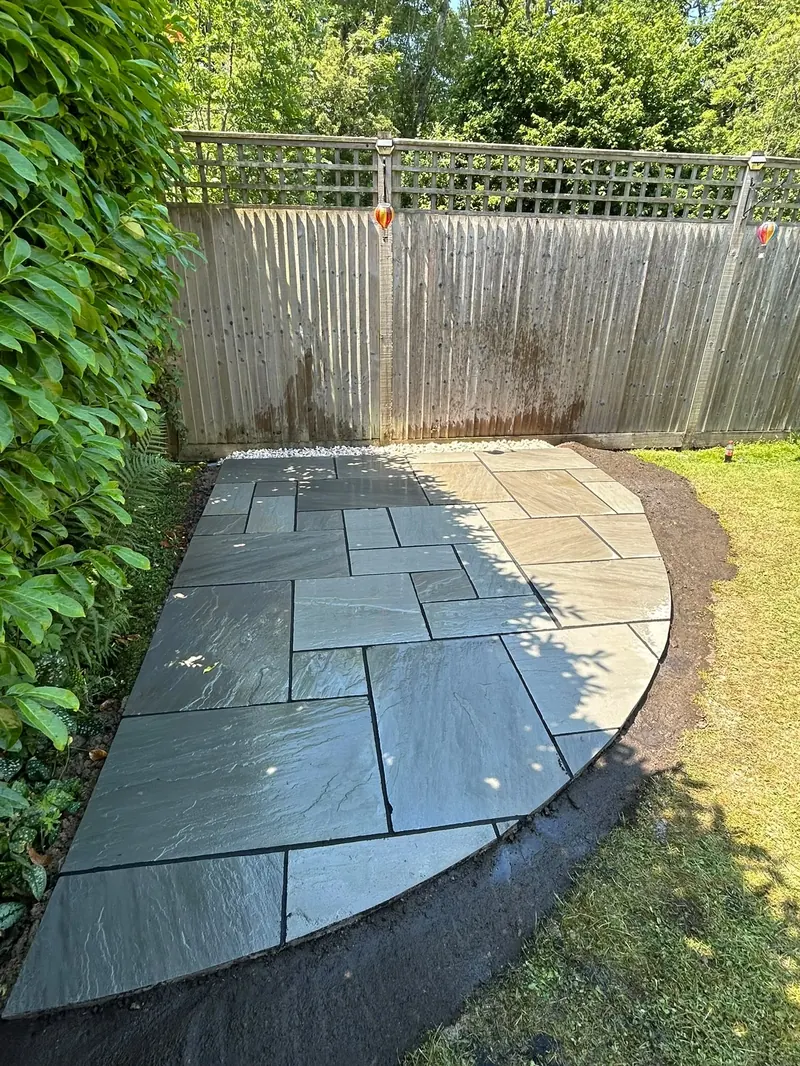
Ask most people to picture a modern patio and they'll probably picture porcelain: flat, uniform, grey slabs, the kind you see in every show garden and half the photos on Pinterest. Sandstone rarely gets a look in, even though for most Horsham gardens it does a very similar job for noticeably less money. HSH Services specialises in patios and paving using sandstone and natural stone, so it's worth being properly upfront about why, rather than just saying "it's cheaper" and leaving it there.
Paving is one of the few garden decisions that's genuinely difficult and expensive to undo once it's in the ground. Get the material choice wrong and you're not just living with a colour you don't love, you're looking at digging up a properly bedded, jointed surface to replace it. That's exactly why it's worth taking the time to understand the real differences upfront, rather than picking on looks alone from a supplier's sample board.
Porcelain paving is a manufactured, kiln-fired material, pressed and fired at very high temperatures until it's extremely dense and low-porosity. That's what gives it its main selling points: a very consistent colour and texture from slab to slab, strong resistance to staining, and very low water absorption, which matters in a wet climate like ours. It's a genuinely good product. The trade-off is cost: because it's manufactured to that level of consistency, the raw material price is usually noticeably higher than natural stone.
Sandstone is a natural stone, quarried rather than manufactured, which means every slab has slightly different texture, colour variation and grain, riven sandstone especially. Some people love that variation because it looks like a real garden material rather than a product; others prefer the uniformity of porcelain. Neither preference is wrong, it's genuinely down to taste. What sandstone consistently offers is a lower material cost for a finish that still looks considered and high quality once it's laid properly.
| Factor | Sandstone | Porcelain |
|---|---|---|
| Typical material cost | Lower, generally the more budget-friendly option | Higher, sometimes significantly so |
| Look | Natural texture and colour variation, riven surface | Very consistent, uniform, often a smoother finish |
| Durability | Durable when laid on a proper sub-base and bed | Very durable, dense and low-porosity by nature |
| Maintenance | Occasional cleaning and, for some finishes, re-sealing to keep colour | Low maintenance, resists staining well |
| Slip resistance | Naturally textured, riven finishes grip well underfoot | Varies by finish, some are very smooth when wet |
| Best suited to | Homeowners who want a natural garden look for less | Homeowners prioritising uniformity and are willing to pay more for it |
Not as much as people assume. Both materials need the same fundamentals underneath: a properly excavated and compacted sub-base, usually type 1 hardcore, a bedding layer, and correctly primed and jointed slabs. The main practical differences show up in cutting (porcelain can be more brittle to cut cleanly) and in jointing, since some porcelain systems use specific proprietary jointing compounds. Neither material forgives a rushed sub-base. Slabs that rock, sink unevenly, or let weeds through within a season almost always trace back to groundwork that was skipped or skimped, not the paving material itself.
Sandstone gives homeowners a similar high-quality, natural finish to porcelain for significantly less money. It's not about cutting corners on the build, every patio still gets the same full sharp sand and cement bed, slurry priming and proper jointing regardless of which material goes on top. It's about choosing a material that gets you a genuinely good-looking, durable result without the porcelain price tag. That's also why the full sandstone vs porcelain guide goes into more depth on the numbers if you want to dig further before deciding.
Porcelain isn't wrong, it's a different trade-off. If a completely uniform, low-maintenance finish matters more to you than the upfront cost, or you're after a very specific contemporary look that porcelain does particularly well, it's worth considering. A straightforward, honest answer either way, not a sales pitch dressed up as advice.
The most common mistake is comparing material prices in isolation, without factoring in the rest of the job. A cheaper slab doesn't automatically mean a cheaper patio: cutting and wastage rates differ between materials, some porcelain ranges need specialist blades and more careful handling, and that time gets reflected somewhere in the final figure even if the headline material cost looks similar. It's worth asking for the full breakdown, materials and labour separately, rather than judging on the per-slab price alone.
Another common mistake is assuming the cheaper material automatically means a lower-quality result. That's not how it works here: sandstone costs less mainly because it's a natural, quarried material rather than a manufactured one, not because less care goes into laying it. The sub-base, bedding and jointing are identical regardless of which stone sits on top.
People also tend to overlook slip resistance until after the patio's laid, then discover a smooth, polished finish is genuinely treacherous near a step or a water feature once it's wet. It's worth asking specifically about the surface finish and its grip rating, especially for areas near doors, steps or anywhere that regularly gets damp, rather than choosing purely on colour and pattern.
Finally, it's worth asking about jointing options before you commit to a material. Some finishes pair better with a brush-in resin joint, others with traditional pointing, and the wrong combination can affect both the look and the long-term durability of the joints themselves.
Whichever material you land on, the groundwork matters more than the slab you pick. HSH Services covers sandstone patios and paving across Horsham, Crawley and Cranleigh, and further afield for larger projects. A recent example of a full sandstone patio and lawn build is covered in the back garden patio transformation case study, if you want to see the process from start to finish.